

Welcome to the all new Drawn to Lead where I break down bigs book into powerful principles with simple sketches. If we haven’t been introduced, my name is Kacy Maxwell and I have been a leader for nearly 20 years. And over the next 12 months I plan to unpack the 12 books that have had a major impact on my journey. My goal is simple, make being a leader a little bit easier. So, let’s get started!
START WITH WHY
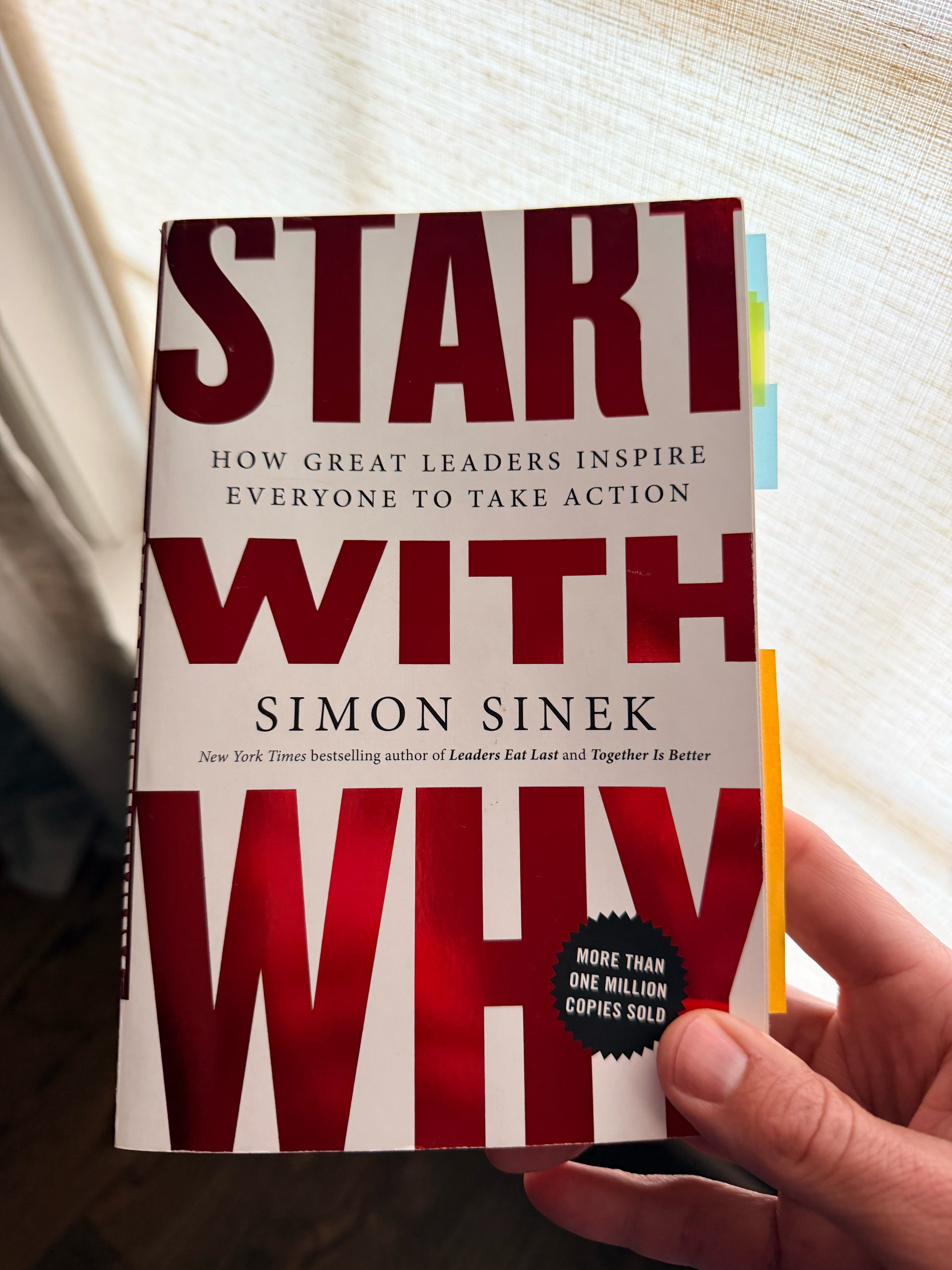
The first book I am digging into is Start with Why by Simon Sinek, not just because the title fits perfectly to kick off this new series, but because the principle that it contains is one that I believe is foundational to leadership: you need to lead with purpose. Hopefully when you read that it sounded loud and had a bunch of echoes in the background. (if not, read it again that way, it makes it sound more dramatic) First, let’s define what I mean by purpose.
Purpose is a funny concept because there are many everyday ways it’s used like:
The purpose of this meeting is to talk about the upcoming event.
Yes, we meant to put that there, we did it on purpose.
That lid serves a purpose. It’s so the drink won’t spill.
And on the other end of the spectrum it can be used in dramatically existential ways like:
What is my purpose in life?!?!
So, which is the right way to think of the principle of leading with purpose? Sinek helps us out by providing a framework that grounds this principle: The Golden Circle. Now, in the book he offers this framework for both leaders and organizations, but for our purposes (there’s that word again), I am just going to focus on the leader side.
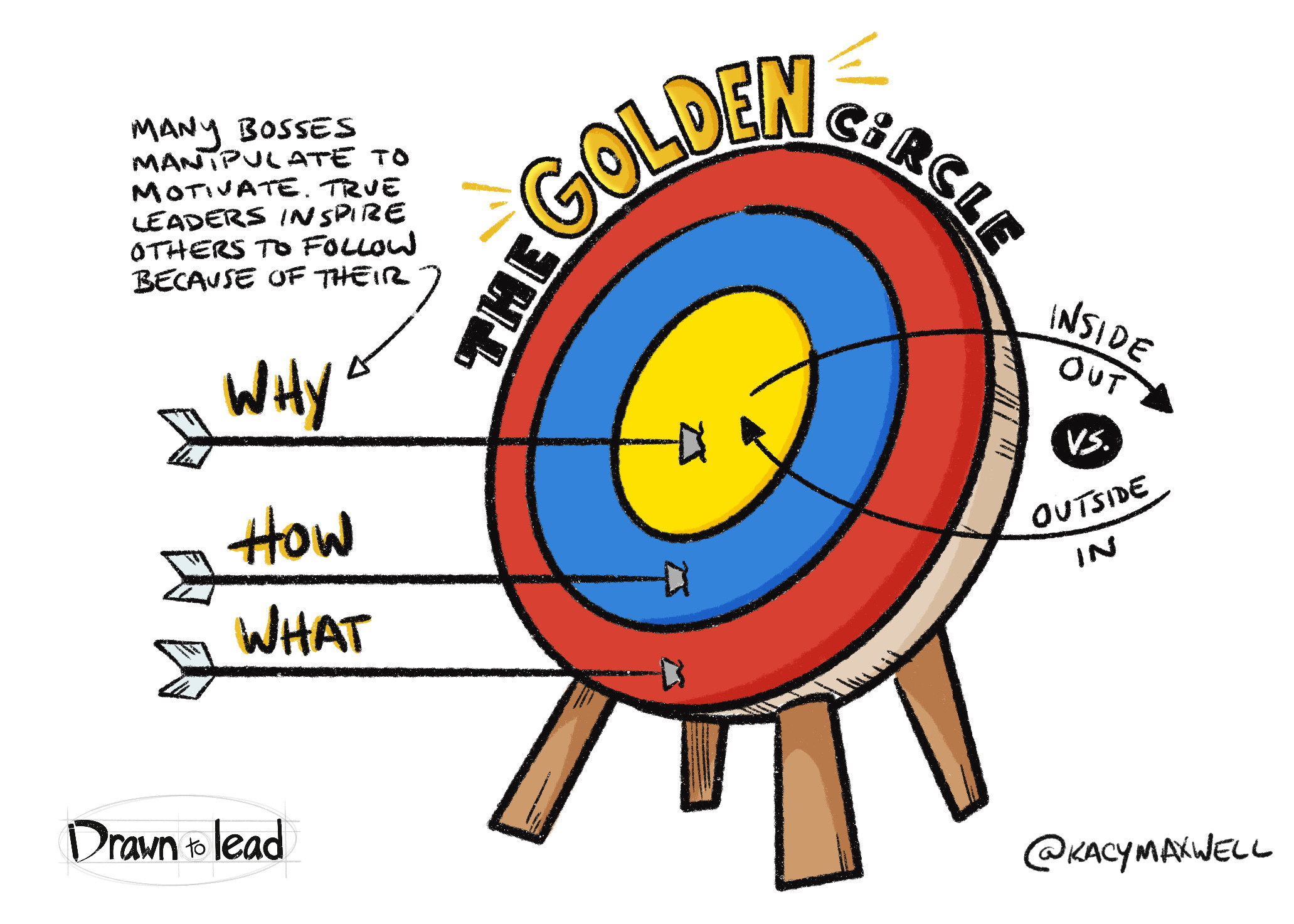
The Golden Circle has three rings. The outside ring is WHAT YOU DO. The middle is HOW YOU DO IT and the inner circle is WHY YOU DO IT. Sinek believes that most leaders start on the outside, first focusing on what they do, then moving to how best they can do it, and often completely neglect why they are doing it. But Sinek proposes that if leaders start with the why and move inside out, teams will be more effective and work harder.
When I thought about how to visualize this concept, an archery target immediately came to mind because of its distinct rings. And the longer I sat with the idea, the more I realized how well this metaphor captured this concept. In archery, the bullseye is the part of the target with the highest value. If you want to win, you need to hit the center of the target. But if you’ve never done archery before, this can be extremely difficult. The same is true of leading with purpose. It’s one of the most important things you can do AND it takes skill and practice to do it well.
But why is it important anyway?
MANIPULATION VS. INSPIRATION
For me, when it comes to understanding the true impact of starting with why, it comes down how you get people to do things. At the end of the day, you really have two options: you can manipulate them or you can inspire them.
Now, manipulation isn’t always negative, and honestly it is the most commonly used motivator in business. This shows up as bonuses, potential promotions, pressure, fear or just because the person with the biggest title wants it done. And I say it is one of the most common tactics in business because it is also the easiest. Many people are motivated by money or power or ego, so it’s easy to manipulate them with these short term incentives. The problem is that those incentives don’t last very long. And when the lose their appeal to the team member, the team member loses their motivation. And you have to keep going back to the well for more to re-motivate which is ultimately unsustainable for the business. You end up creating a culture that is focused solely on these manipulations, and not on what you want them to be focused on —> doing their jobs exceptionally well!
“Great leaders, in contrast, are able to inspire people to act. those who are able to inspire give people a sense of purpose or belonging that has little to do with any external incentive or benefit to be gained. Those who truly lead are able to create a following of people who act not because they were swayed, but because they were inspired.” (Start With Why)
And when your team is inspired, they approach their work so much differently. When you give your team a purpose that extends beyond revenue targets or goal completions, you give them something that speaks to what we all want in our roles: a purpose. We all want to know that what we are doing matters and to get that, we have to understand why it matters! I love the story that Sinek shares to illustrate how purpose can change your team’s perspective.
He tells a story of two stonemasons. The first is asked if he likes his job. He wipes his brow and says, “the work is monotonous, the rocks are heavy, and building this wall is breaking my back. But it’s a job and it pays the bills.” The second is asked the same question, if he likes his job? He replies “I love my job! I’m building a cathedral! Sure it’s hot, the stones are heavy and the work is monotonous. But I’m building a cathedral!” Same hard job. Different perspective. One knows the task. One sees the purpose. Now ask yourself, which one of these two is going to work harder?
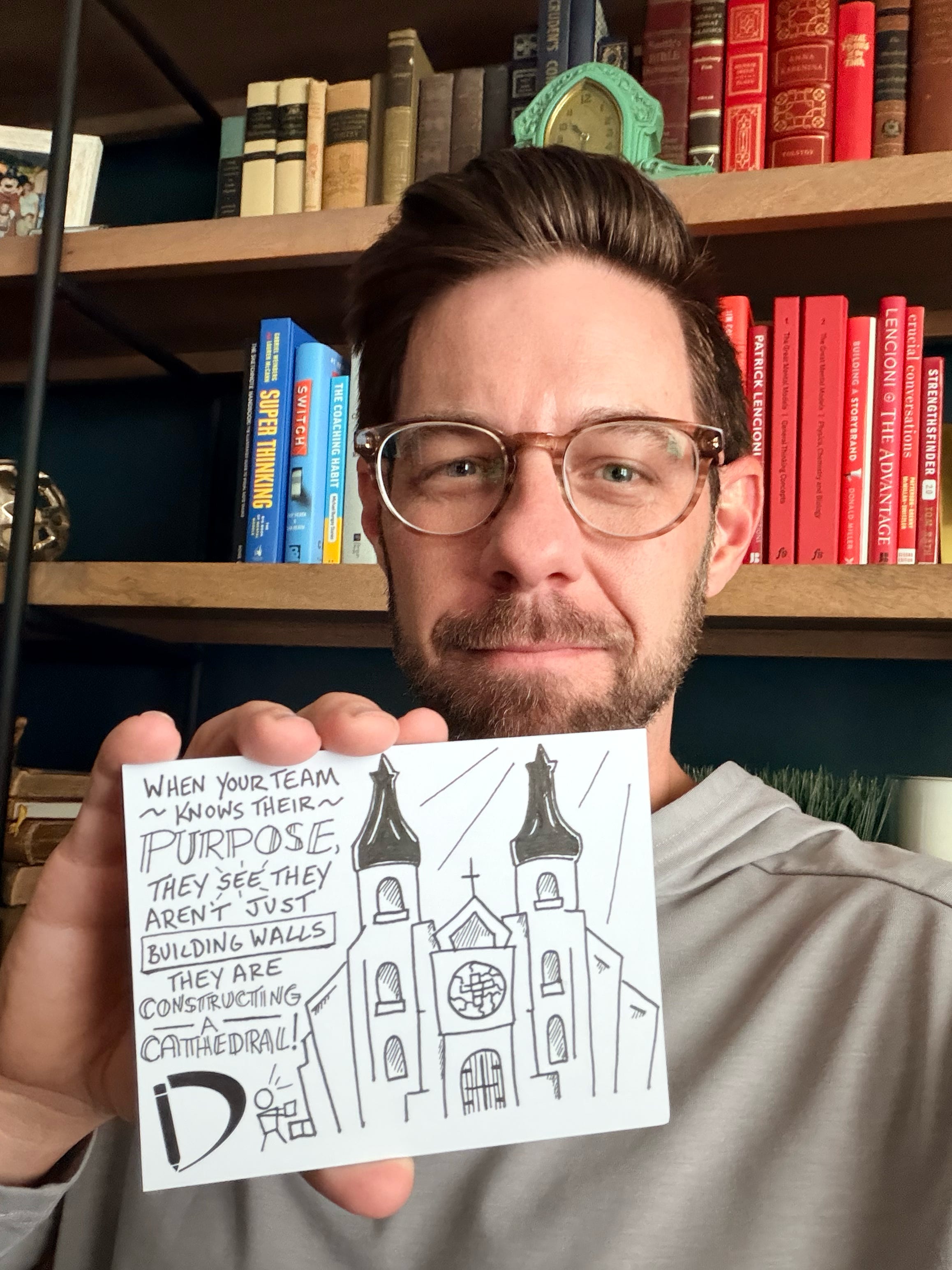
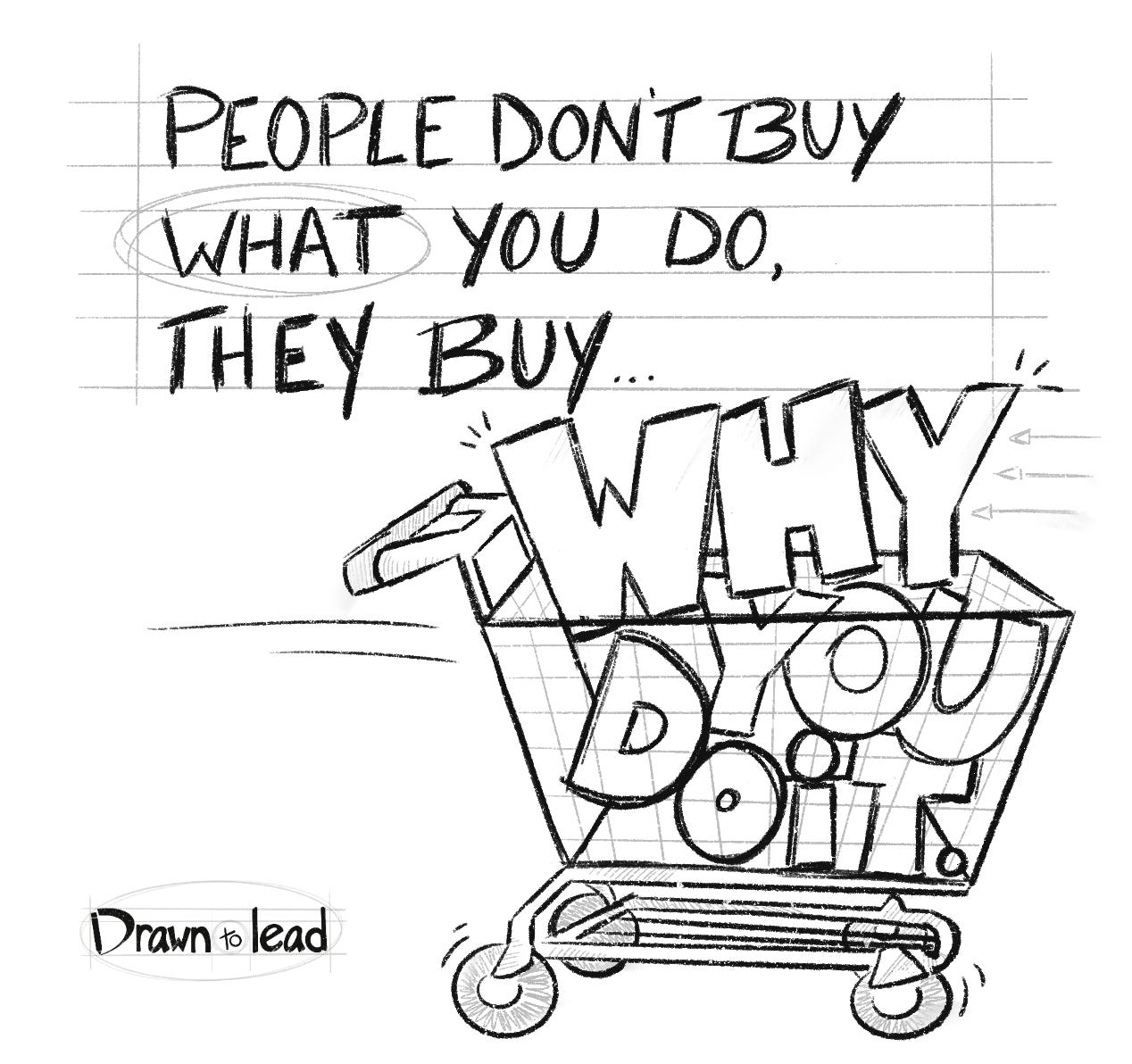
People Don’t Buy WHAT You Do. They Buy WHY you do it.
So what does this look like in real life? How do you take a concept like purpose and inspiration and make it applicable? Let me give you two different examples from my leadership journey, one bad and one good.
THE BAD
I was a new leader who had recently joined a small team of 5 people. My boss had shared with me that she wanted an area of our website changed. (I lead marketing teams by the way). She told me WHAT she wanted done. So I gathered my team, and shared with them WHAT needed to be changed. My expectation was the team would snap to attention and go start making the requested updates. I was the leader after all. Instead, the amount of frustration and pushback I received was shocking. Not only had I completely neglected to acknowledge all the work that had gone in to create the current version, I didn’t have a good answer when they asked the most important question ‘WHY does it need to change?’ And the answer ‘because the boss said so’ wasn’t good enough. We ended up getting the section updated, but it took so much longer to get the team on board and no one was excited about the project, even when it was done.
THE GOOD
I was pulled into a meeting and told that there was a big problem on our website. There was too many options and people didn’t know where to start. And my team needed to fix it. This was after the the bad story and I knew coming and and telling my team WHAT they needed to do was not going to work. So instead, I sat down and spent some time thinking about the WHY, and how I could get my team excited to solve this problem with me. I gathered my team together and excitedly announced, PROJECT WHITE GLOVE. I explained as owners of the website experience, it was our job to give people the best experience possible every time they visited the site. And if our visitors left confused, we had failed them. Then I passed out boxes that contained actual white gloves and said our mission this quarter is to give our visitors a white glove experience! Then I invited them to help me figure out HOW we would do it and WHAT would we need to build to make it happen. The result was a team that was fully bought in on. The WHAT ended up being an simple assessment that helped a ton of people get started and was a huge success for our company.
Figuring Out Your WHY
Hopefully you’ve gotten an idea of what leading with purpose looks like. It’s easy to dismiss this or call it a nice to have. But I can guarantee you that the times that I have ignored this, or worked for organizations that have, it has made leadership so. much. harder. Helping define a purpose for your team is your responsibility. Sinek adds this important line in the afterword of this book but sums up purpose so clearly…
“Leadership requires two things: a vision of the world that does not yet exist and the ability to communicate it.” (Start With Why)
And here is where you need to do some of the work to make this stick for you. Below are a few questions that you should take some time to think, and maybe journal, about to help get your mind thinking in the right direction. And just so you don’t feel too bad if you don’t do this regularly enough yet…85% of leadership teams spend less than one hour per month on strategy, and 50% spend no time at all on strategy. (Harvard Business Review, 2005)
Do you rely more on inspiration vs. manipulation to motivate?
How would you want the people you lead to describe you?
Do you often bring your team the WHAT vs. the WHY?
Which type of stonemason do you want on your team?
And finally, WHY do you want to be a leader?
And if you like questions, I created a free assessment for you to see where you fall on the 6 key leadership mindset shifts. Interested?
What’s Next…
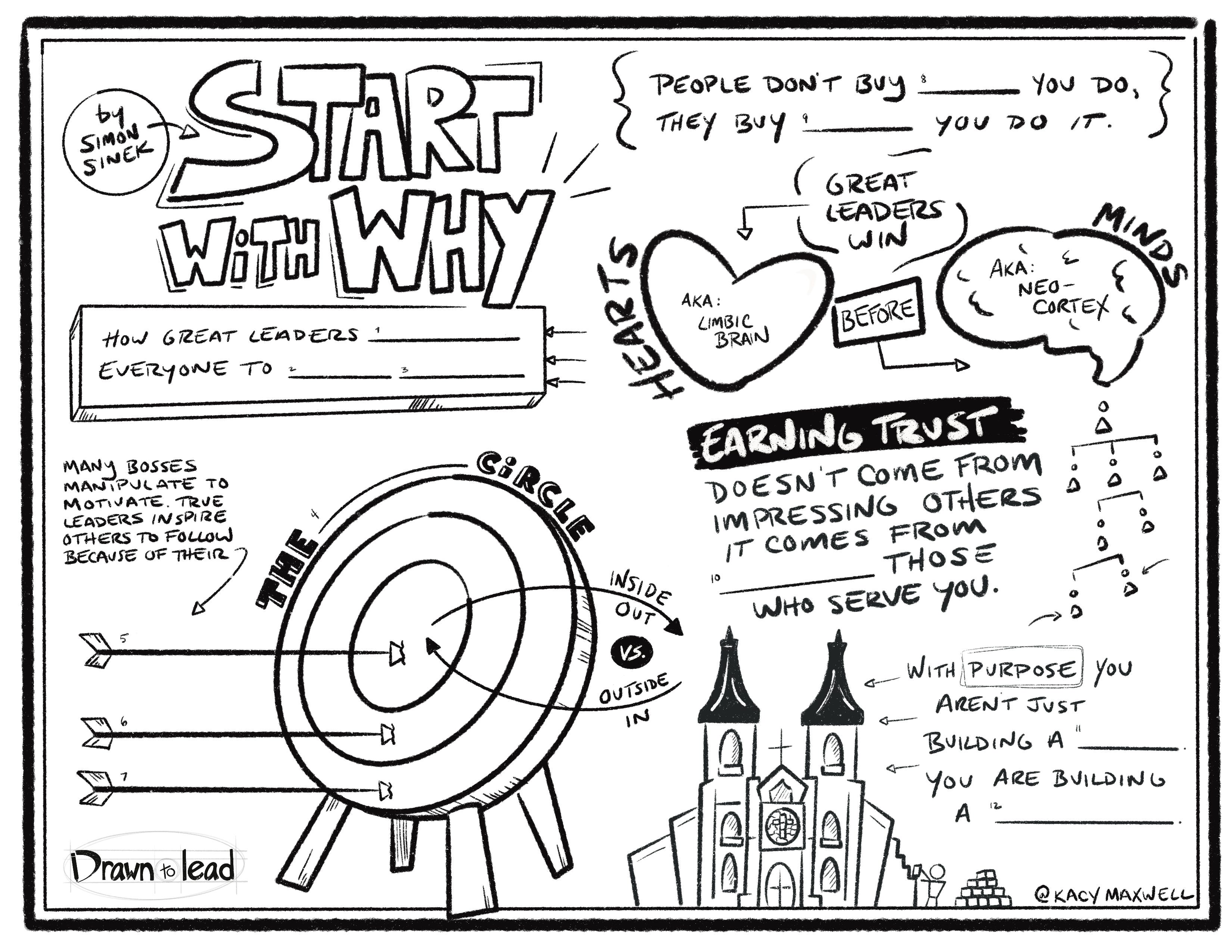
If you haven’t already, I think you should consider purchasing this book. Even if you’ve already read it, books are awesome because you get different things out of them when you read them in different seasons. And to help, I created a fill-in-the-blank sketchnote for you to walk through some key concepts in the book!
Coming Up Next…
My next post will feature a book study video with two amazing leaders. We unpack more about this book and the principle of leading with purpose. Love to hear your thoughts on this post. Also, if you would consider upgrading to paid, it would help support me on this mission! (or just forwarding this on to another leader that would find it helpful!
More to come.
Kacy @ Drawn to Lead
I've tried to comment on this 3 times, and in the process, my comments disappear haha 🥲 The why is pretty important haha, but I've experimented with situations where teams were only guided by "I need money to live"; entire companies were guided by this. I struggled a lot with this haha, but I lived other experiences on the opposite side; in the Air Force Academy of my country, I saw a lot of guys who inspired us every day, because we had the purpose principally to fly haha. It was very demanding, and with purpose, nothing feels better haha. Sadly, I think of the final purpose in the army haha, and I think about other things, and I see that I did not want that haha. But thanks to that experience, I discovered what this book says haha. The why is pretty important to lead and to give others the opportunity to share their talents freely.
I’m a huge fan of Simon Sinek. His work around purpose is foundational to my current work. And ikigai adds a layer of insight that’s worth understanding.
I’ve written about both through my own experiences.
Today, I’m focused on the under explored middle ring: HOW.
I’m not talking about the how associated with systems, processes, or a company’s unique value proposition.
I’m talking about the power of HOW.
My contention is the how we do what we do — how we lead — is as important as what we achieve.
And I’m on a quest to help leaders turn values that hang on the wall into virtue-driven action.